Table of Contents
Modularity in Window Manufacturing Machinery: Why Product Variants Become an Architectural Question
Window manufacturing machines today must cover an enormous range of requirements. Different profile geometries, materials, and customer-specific production concepts result in a high degree of product variety. For OEMs, the question increasingly arises as to how new requirements can be integrated without software, interface, and engineering effort growing at the same rate.
The following article explains why modularity and platform thinking are gaining importance in this context and the role that an end-to-end system architecture plays for the scalability and further development of machine concepts.
The Challenge Grows with Product Variety
Whether sawing, milling, drilling, welding, or cleaning: the processing of PVC, aluminum, and wood profiles each places its own specific demands on machine design and automation. For manufacturers of such machines, this results in a wide range of possible configurations.
This diversity has been a core aspect of the window machinery industry for years. At the same time, market requirements are evolving. Customers expect flexible system concepts that can accommodate different product variants and adapt to new requirements. Extensions should be possible without fundamental modifications wherever possible. In addition, machine platforms are often developed further over many years.
This creates a dual challenge for machine builders. On the one hand, new functions and variants must be implemented. On the other hand, existing solutions should be reused wherever possible. As a result, the question of how additional requirements can be integrated economically is becoming increasingly important. Equally critical is how machine platforms can be further developed throughout their entire lifecycle.

When Additional Variants Create New Complexity

System Architecture as a Decisive Factor

Modularity as a Response to Growing Requirements

Only the Communication Architecture Makes Modularity Scalable

Platform Architecture in Practice: The Motion Control Ecosystem
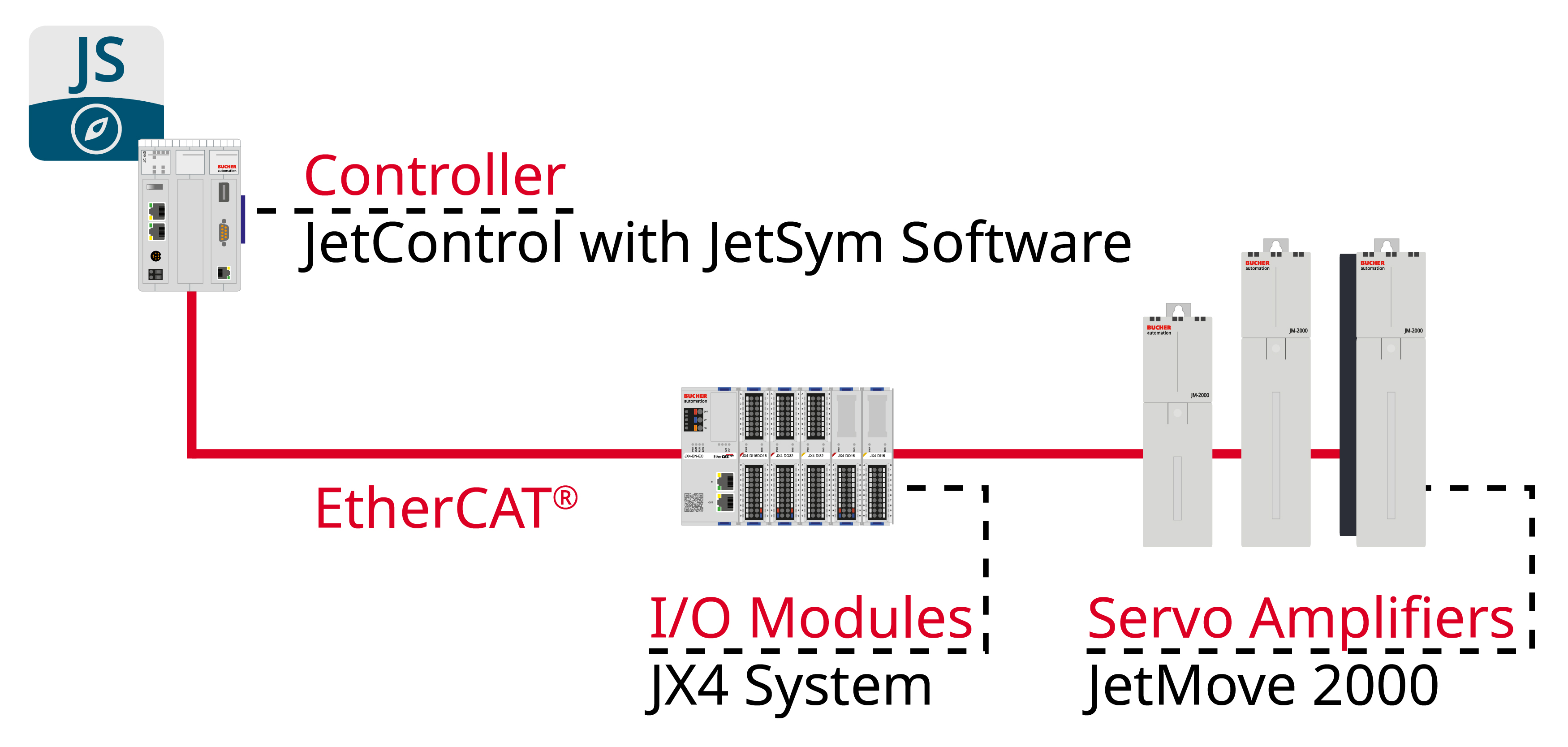
For a modular approach to work in practice, software, control systems, drive technology, and peripherals must interact seamlessly. This is exactly where the Motion Control ecosystem from Bucher Automation comes into play.
The platform combines the JetSym development environment, the JetControl control system, the JetMove drive technology, and the decentralized JX4 I/O system into an integrated system architecture. The objective is to systematically leverage recurring functions and simplify the integration of additional machine variants.
A Common Basis for Development and Integration
JetSym provides the common engineering foundation. Function-oriented modules for motion control as well as for coordinating machine sequences form the basis for reusing software components across different machine configurations. JetControl handles the central control layer and ensures that functions interact within a unified architecture.
JetMove enables precise and synchronized motion sequences, even in complex multi-axis applications. JX4 supports the flexible integration of peripherals and facilitates the implementation of modular machine structures.
Why Platforms Offer More Than Individual Components

How modularity pays off across the entire lifecycle of window manufacturing machines
Service and maintenance benefit as well. When functions are based on shared standards, clear advantages emerge:
- Troubleshooting becomes more transparent, as all systems are based on the same structures
- Adjustments are easier to plan, since extensions build on existing solutions
- New requirements can be implemented in a more structured way, without isolated developments
- Future expansions can be integrated efficiently, as existing functions can be reused
In addition, a shared platform facilitates knowledge transfer within the organization:
- Engineering teams work on a consistent foundation
- Proven solution approaches can be leveraged across projects
- Onboarding efforts are reduced
- Further development of the machine platform becomes more uniform and efficient
As a result, the motion control ecosystem not only supports the technical implementation of modular machine concepts. It also creates the conditions to manage product variety economically and make existing know-how sustainably usable.
Conclusion

Learn more about the products


Why product variety in window manufacturing becomes a complexity issue
FAQ
Why is modularity becoming increasingly important in window manufacturing machinery?
The variety of variants in window production is continuously increasing. Different profile geometries, materials, processing methods, and customer-specific system concepts mean that machines must become ever more flexible. Modularity helps integrate new requirements without causing a disproportionate increase in software and engineering effort.
What advantages does a platform architecture offer for OEMs?
A shared platform architecture enables the reuse of proven software modules, standardized interfaces, and consistent engineering processes. This allows new machine variants to be developed more quickly, expanded more easily, and maintained more efficiently. At the same time, existing engineering know-how remains usable in the long term.
Why does the communication architecture play such a major role?
Modular machine concepts only work if all components communicate with each other reliably and in sync. Especially in highly dynamic motion control applications, real-time capability and deterministic communication are crucial. Fieldbus systems such as EtherCAT provide the technological foundation for flexible and scalable machine architectures.
How does modularity help reduce engineering effort?
Without a clear architecture, project-specific custom solutions and differing software versions often emerge over time. This significantly increases maintenance and development effort. Modular systems, on the other hand, enable the reuse of standardized function blocks. New features can be parameterized or combined instead of being redeveloped from scratch each time.
What role does platform thinking play in the future of automated window manufacturing?
In the future, window manufacturing will become increasingly data-driven, flexible, and software-centric. Platform thinking creates the foundation for this by ensuring that machine families remain extendable, scalable, and maintainable over the long term. For OEMs, this is becoming a strategic competitive advantage - especially as product variety increases and automation levels continue to rise.